The Discipline Gap
Why Good Strategies Die in Growth-Stage Companies
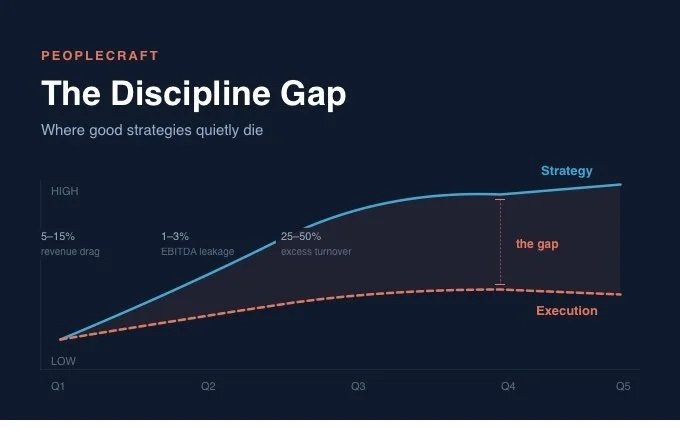
Most growth-stage and PE-backed companies don't fail because of bad strategy. They fail because of weak follow-through.
We call this the discipline gap — the space between what leadership decided in the offsite and what actually shows up in the business 90 days later.
You've probably seen it. The value creation plan is solid. The slides are sharp. The leadership team nods. Then Q2 ends and hiring is still behind, the new comp plan isn't live, managers are improvising, and the same three issues resurface in the board meeting.
Nothing was wrong with the plan. The discipline to operate it wasn't there.
What the discipline gap actually looks like
In the companies we work with, it shows up in predictable ways:
Priorities drift quarter to quarter because nothing is tracked week to week
Managers don't know what "good" looks like in their own role, so they optimize for activity instead of outcomes
Decisions get made twice — once in the room, then re-litigated a month later because no one wrote them down
HR, finance, and ops each have their own version of the truth on headcount, turnover, and spend
"We'll fix that next quarter" becomes the operating rhythm
The cost isn't theoretical. Slow hiring drags 5–15% of revenue. Misaligned comp and org design leak 1–3% of EBITDA. Post-acquisition, regrettable turnover runs 25–50% higher in the first year. Every one of those numbers traces back to execution discipline, not strategy.

“We’ll fix it next quarter”
Fix it before it becomes too late to fix it.
Why founder-led and PE-backed companies are especially exposed
Founders and CEOs are wired for speed and intuition. That's an asset in the early innings. At $20M, $50M, $100M of revenue, it becomes a liability. The company outgrows the founder's ability to hold everything in their head, and there's no operating system underneath to catch what falls.
PE-backed companies face a tighter version of the same problem. The hold period is finite. Every missed quarter compounds into delayed value capture — we typically see 16–20 months of lost time on integrations that lacked people leadership. Sponsors don't forgive that easily.
What closes the gap
Discipline isn't about working harder or adding process for its own sake. It's about a small number of non-negotiables, operated relentlessly:
A weekly cadence that actually runs. CEO 1:1, leadership sync, workstream standups. Same day, same format, same KPIs. When the rhythm slips, execution slips with it.
A decision log. Boring, unglamorous, enormously valuable. Write down what was decided, by whom, and when. You'll cut re-litigation by half.
3–5 OKRs the whole leadership team can recite. Not 15. Not "strategic themes." Real objectives with real key results, reviewed on a real cadence.
A manager operating standard. Goals set, 1:1s held, performance conversations happening. Measure it. Managers are where strategy either lands or dies.
One scorecard. Hiring, retention, manager index, revenue per FTE, compa-ratio. One page. Shared weekly with the leadership team, monthly with the board.
None of this is new. None of it is complicated. The reason it doesn't happen isn't knowledge — it's the absence of someone senior enough to hold the line when the quarter gets hard.

One-on-one meeting between a manager and an employee.
The bottom line
Strategy is cheap. Discipline is rare. In growth-stage and PE-backed environments, the companies that pull away from the pack aren't the ones with the smartest plan — they're the ones that actually run it.
If your leadership team can't tell you, in 30 seconds, the top 3 people priorities this quarter and how they're being measured, you have a discipline gap. And it's probably costing you more than you think.