Your AI Strategy Is Letting Institutional Knowledge Walk Out the Door
Most companies are doing task elimination and calling it task decomposition. The cost shows up two quarters later, and it's not on the CFO's spreadsheet.
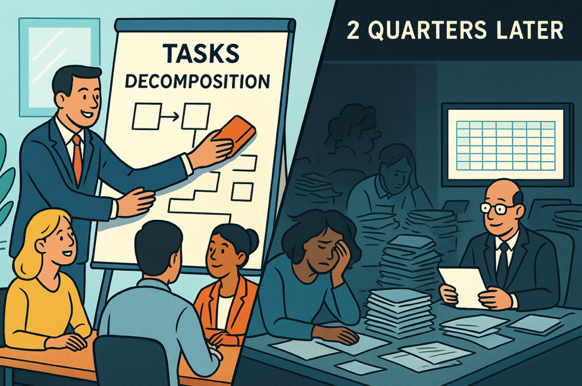
Most companies are buying AI before they've defined the work. That's why most pilots stall. And it's why the "task decomposition" exercises happening in boardrooms right now aren't actually task decomposition. They're task elimination wearing a consultant's deck.
The difference matters. When you skip the real work, you don't just lose efficiency. You lose the institutional knowledge that made the role valuable in the first place. The CFO sees a clean line item for cost savings. The CHRO calls the breakage two quarters later "bad luck." It's neither.
Here's what real task decomposition is, and what most companies are doing instead.
What Task Decomposition Actually Is
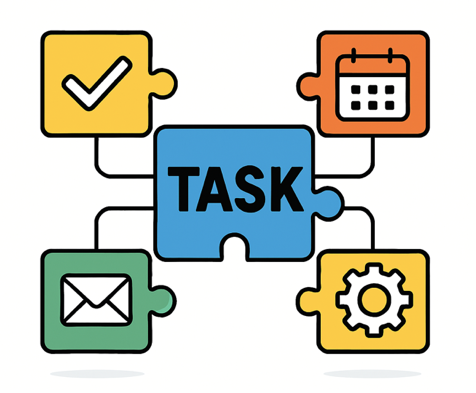
Real task decomposition has two layers and four fates.
The Two Layers
The explicit layer is the task list: what the person does in a normal week. "Reconcile inter-company balances." "Draft a candidate rejection email." "Run the Monday pipeline standup." This is the visible work. It's easy to write down. It's easy to hand to an AI tool.
The tacit layer is everything that surrounds the tasks. Why the Q3 accrual always looks weird. Which vendor actually returns calls. The customer who churned three years ago and what never to say to her successor. The edge cases. The workarounds. The judgment built from doing the work ten thousand times.
The tacit layer is what makes the explicit work valuable. It's also what makes the person hard to replace. And it's the layer that gets ignored when companies rush to automate.
The Four Fates
Every task in your organization has four possible outcomes when AI enters the picture. Not two. Four.
Automate. AI handles the task fully. The work happens without human input.
Redistribute. Another human absorbs the task with a documented capacity plan, not as a quiet add-on.
Redesign. The task itself reshapes because AI changed the upstream input. The work is different now, not gone.
Preserve. You keep the task human on purpose because judgment, relationships, or stakes require it.
The lazy version of decomposition has only two options: automate or leave alone. That's not decomposition. That's a procurement decision dressed up as strategy.
Task Decomposition and the Four Fates
What Companies Are Actually Doing
What I'm seeing in not only PE-backed portfolios, but companies across the board right now is a corrupted version of this work, and it follows a predictable pattern.
A company lists the tasks in a role. They identify the 30% AI can handle today. They eliminate the role to claim the savings. Then one of two things happens to the other 70%:
The tasks get orphaned. Nobody formally owns them, so they quietly stop happening. Nobody notices for a while. Then a customer complaint, a missed renewal, or a botched audit reveals the gap.
Or the tasks get absorbed, by an already-overworked manager who didn't ask for them, doesn't have time for them, and now does them in the margins. Quality drops. Morale drops. Within a year, that manager is interviewing elsewhere.
In both cases, the tacit layer is gone. Nobody wrote down what the person knew.
The relationships, the edge-case judgment, the workarounds… they walked out the door with the headcount.
The Cost Shows Up Two Quarters Later
The financial damage is the part nobody models in the AI business case.
Two quarters after the role elimination, something breaks that the person who left would have caught. A revenue recognition error. A key customer escalation. A compliance miss. A talent walk in a critical function.
The CFO sees a one-time cost and a clean explanation. The CHRO calls it bad luck. It's neither. It's the predictable result of half-decomposition, and it's becoming a recurring pattern across the industries I work in.
This is the part of the AI conversation almost nobody is talking about. The savings line is easy to put on a slide. The breakage doesn't show up until two quarterly board meetings later… by which time the original AI decision is too far back to connect to the new problem.
Costs hitting two quarters from now
What Real Decomposition Looks Like
The companies doing this right are doing four things differently.
They map the tacit layer before they touch the tasks. Before any role is reorganized, the institutional knowledge gets captured: interviews, documented workflows, decision logs, relationship maps. This is the unsexy work. It's also the work that separates real transformation from headcount math.
They assign each task to one of the four fates explicitly. Not "we'll figure out the rest later." Every task lands in a bucket with an owner and a date.
They build capacity plans for the redistribute tasks. If a task is moving to another human, that human's workload is rebalanced. Real hours, real tradeoffs, real conversations.
They preserve more tasks than they expected to. When you actually look at what AI can do well today versus what it produces noise on, the "automate" bucket is smaller than the vendor demos suggest. The companies that match reality to capability ship better outcomes.
This is the work. It takes longer. It costs more upfront. It also produces results that hold up two quarters out, which is the only timeframe that actually matters.
What to Do Now
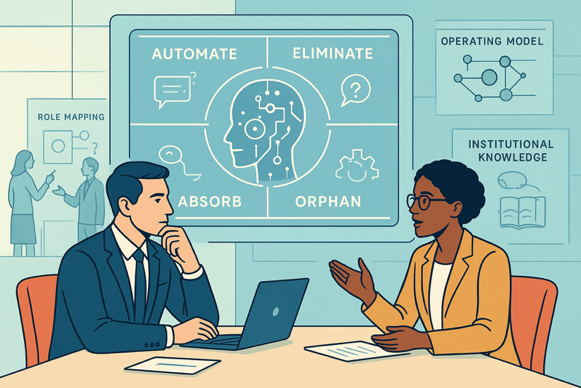
If you're a CEO or sponsor with AI investment on your near-term roadmap, ask three questions before you sign off on another tool:
Have we mapped the tacit layer of the roles we're about to change? If the answer is "we have the JD," that's not the tacit layer. That's the job posting.
Have we assigned every task in the affected roles to one of four fates — not two? If the only options on the table are automate or eliminate, you're funding half-decomposition.
Who owns the orphaned and absorbed tasks two quarters from now? If you can't answer this, you've already lost the institutional knowledge. You just don't know it yet.
The AI conversation isn't a procurement problem. It's an operating model problem. The companies that figure out the difference will compound. The ones that don't will spend the next three years explaining to their boards why the savings on paper didn't show up in EBITDA.
What to do Now
John Skeffington is the founder of PeopleCraft HR, providing fractional CHRO advisory and people due diligence to fast growing companies, private equity sponsors, and their portfolio companies. If your company or portfolio is staring at an AI workforce decision right now, reach out for a conversation.